
Tag «alternative medicine»

Acupuncture Science 9: Mechanical Signaling

Part 9: Mechanical signaling as a mechanism for Acupuncture To date, modern medicine has linked much of the acupuncture mechanism of action to the nervous system, and primarily to the concept of ‘‘Gate control theory of pain’. Based on this theory, acupuncture needling or electrical stimulation is said to activate relevant neural pathways. However, this …
Acupuncture Science 8: Arrival of Qi

Part 8: Arrival of Qi (De Qi) The phenomenon of “Arrival of Qi” (De Qi) has been described as a vital part of the effectiveness of an acupuncture treatment. It is described as a sensation of soreness, numbness or a feeling of distension around the point after the needle is inserted to a certain depth. …

Acupuncture Science 7: Meridians & Fascia

Part 7:  Do Meridians lines lie in fascia? Fung (2009) hypothesised that TCM meridian system upper boundaries are the skin with dense sensory receptors of various types, while the lower boundaries are another layer of connective tissue with interstitial fluid flowing through. Numerous other studies suggest the most probable location is the fascia just beneath …

Acupuncture Science 6: TCM Meridians

Part 6:  What are TCM Meridians ? According to Traditional Chinese Medicine (TCM) text Qi flow in a network of meridian channels found all over the body, but despite scientific efforts we have yet to find the modern biomedical equivalent. There are 12 major meridians, supported by 8 extra meridians, 15 collaterals and others. Each …

Acupuncture Science 5: Western & traditional

Part 5:  Integrating Western Physiology with Traditional Chinese Medicine Philosophies With its 5,000-year-old history, Traditional Chinese Medicine (TCM) has been widely recognised for its knowledge and therapeutic approach. Although still not fully understood, there is every reason for it to contribute to the future development of modern medicine. Admittedly, researchers have yet to be able …

Acupuncture Science 4: Chinese diagnosis

Part 4:  Chinese Medicine Diagnosis: A Balancing Act Traditional Chinese Medicine (TCM) diagnosis constitutes four basic methods: inspection (of the physical body or coating on the tongue), auscultation (listening to speech, breathing or coughing), olfaction (of mouth or body odour), inquiry (of symptoms) and palpation (of pulse or abdomen), very much similar to modern medical …

Acupuncture Science 3: Five Elements Theory

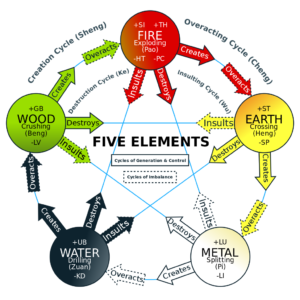
Part 3: Five Element Theory Following Yin and Yang theory in the 3rd century, the Five Element theory was introduced, which helped to understand the body as an interlinking system, where body functions are controlled through the actions of stimulation and inhibition.  As with other Chinese philosophies, this system is also based on observations made …

Acupuncture Science 2: Qi

Part 2:  Qi: Vital Energy, Life Force In Chinese philosophy, Yin and Yang are created by Tao (nature’s creative force). Within this also originates the flow of life force called ‘Qi’ (pronounced Chi). Qi is described as vital energy or life force that exists in nature and all life, in the form of movement and …

Acupuncture Science 1: How does it work?

Part 1:  How Does Acupuncture Work  ? “How does acupuncture work ?” is a question often asked of an acupuncturist. The acupuncturist will try to explain concepts of ancient Traditional Chinese medicine (TCM) philosophies, talking about blocked energies, meridians and qi. For some, it will make absolutely no sense, while others will be fascinated and …

➤