
Category «Acupuncture»

3. “Interstitium”: Can this new Organ explain Acupuncture ?

One would have thought that anatomist would have discovered everything there was to discover in the human body. Au Contraire!  Hidden in plain sight researchers discovered the “Interstitium”; a mesh network of fluid filled spaces that lies along the web of collagen and elastin tissues throughout the body. It is estimated to be 20% of …
2. Acupuncture and heat increases Nitrous Oxide production

Acupuncture has a long history of use to treat many conditions, including pain, depression, fatigue and addictions.  It is known to effect local responses as well as distal changes through neurological and endocrine systems. When used together with heat treatment it can cause multiple biological responses, seen both in animals and humans.  However, the mechanism and …

Acupuncture points for Seasonal Allergies

Gradually we are moving from spring to summer and the combination of sun, fresh flowers and warm air, but for some its means puffy itchy red eyes, runny noses, sneezing and headaches. Good News! although the seasons are unavoidable, the need for antihistamines and a constant supply of tissues can be avoided with a few …

1.9: Mechanical Signaling

Mechanical signalling as a mechanism for Acupuncture To date, modern medicine has linked much of the acupuncture mechanism of action to the nervous system, and primarily to the concept of ‘‘Gate control theory of pain’. Based on this theory, acupuncture needling or electrical stimulation is said to activate relevant neural pathways. However, this theory does …

1.8: Arrival of Qi (De Qi)

Arrival of Qi (De Qi) The phenomenon of “Arrival of Qi” (De Qi), is described as a vital part of the effectiveness of an acupuncture treatment. It is described as a sensation of soreness, numbness, or a feeling of distension around the point after the needle is inserted to a certain depth. At the same …

1.7: Meridians & Fascia

Do Meridians lines lie in fascia? Fung (2009) hypothesised that TCM meridian system upper boundaries are the skin with dense sensory receptors of various types, while the lower boundaries are another layer of connective tissue with interstitial fluid flowing through. Numerous other studies suggest the most probable location is the fascia just beneath the subcutaneous …

1.6: TCM Meridians

What are TCM Meridians ? According to Traditional Chinese Medicine (TCM) text Qi flow in a network of meridian channels found all over the body, but despite scientific efforts we have yet to find the modern biomedical equivalent. There are 12 major meridians, supported by 8 extra meridians, 15 collaterals and others. Each of the …

1.5: Integrating the East & West

Integrating Western Physiology with Traditional Chinese Medicine Philosophies With its 5,000-year-old history, Traditional Chinese Medicine (TCM) has been widely recognised for its knowledge and therapeutic approach. Although still not fully understood, there is every reason for it to contribute to the future development of modern medicine. Admittedly, researchers have yet to be able to successfully …

1.4: Chinese diagnosis

Chinese Medicine Diagnosis: A Balancing Act Traditional Chinese Medicine (TCM) diagnosis constitutes four basic methods: inspection (of the physical body or coating on the tongue), auscultation (listening to speech, breathing or coughing), olfaction (of mouth or body odour), inquiry (of symptoms) and palpation (of pulse or abdomen), very much similar to modern medical clinical methods. …

1.3: Five Elements Theory

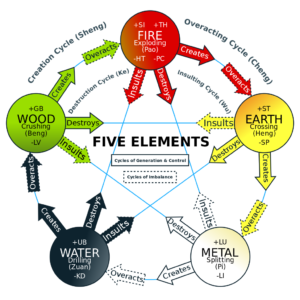
Five Element Theory Following Yin and Yang theory in the 3rd century, the Five Element theory was introduced, which helped to understand the body as an interlinking system, where body functions are controlled through the actions of stimulation and inhibition.  As with other Chinese philosophies, this system is also based on observations made of the …

➤